PUWER vs LOLER: What's the Difference, and When Do They Apply?
Introduction
If you manage or operate work equipment in the UK, you have almost certainly encountered the terms PUWER and LOLER. These two sets of regulations are fundamental to workplace safety, yet they are frequently misunderstood or used interchangeably.
In reality, PUWER and LOLER serve different purposes and apply to different types of equipment -- though there is significant overlap. Getting the distinction right is not just a matter of compliance; it directly affects the safety of your workforce and the legal standing of your business.
This article breaks down each regulation, highlights where they differ and where they converge, and explains what practical steps you need to take to stay on the right side of both.
What Is PUWER?
The Provision and Use of Work Equipment Regulations 1998 (PUWER) is a broad set of regulations that applies to virtually every piece of equipment used in the workplace. Its purpose is to ensure that all work equipment is:
- Suitable for its intended use
- Maintained in a safe condition
- Inspected at appropriate intervals
- Used only by people who have received adequate training and information
PUWER applies to everything from hand tools and office furniture to industrial machinery, conveyor systems, and vehicles used for work. If it is used at work, PUWER almost certainly applies.
Key PUWER Requirements
- Suitability: Equipment must be suitable for its intended purpose and the conditions in which it will be used.
- Maintenance: Equipment must be maintained in an efficient state, in efficient working order, and in good repair.
- Inspection: Where there is a significant risk, equipment must be inspected after installation, after reassembly, and at suitable intervals thereafter.
- Training: All persons using, supervising, or managing work equipment must have adequate training.
- Guarding: Dangerous parts of machinery must be guarded to prevent access or stop movement before contact.
What Is LOLER?
The Lifting Operations and Lifting Equipment Regulations 1998 (LOLER) is a more targeted set of regulations that applies specifically to equipment used for lifting and lowering loads, including people. Its purpose is to ensure that lifting operations are:
- Properly planned by a competent person
- Appropriately supervised
- Carried out in a safe manner
LOLER covers cranes, hoists, forklifts, passenger lifts, goods lifts, mobile elevating work platforms (MEWPs), lifting accessories (slings, shackles, chains), and any other equipment whose principal function is to lift or lower a load.
Key LOLER Requirements
- Thorough Examination: All lifting equipment must undergo a thorough examination by a competent person at statutory intervals -- typically every 6 months for equipment used to lift people or lifting accessories, and every 12 months for all other lifting equipment.
- Planning: Every lifting operation must be properly planned, appropriately supervised, and carried out in a safe manner.
- Safe Working Load (SWL): Lifting equipment must be clearly marked with its SWL and must not be used beyond that limit.
- Reports: A report of thorough examination must be provided by the competent person, and any defects must be rectified within the specified timeframes.
PUWER vs LOLER: The Key Differences
The table below summarises the main distinctions between the two regulations:
| Aspect | PUWER | LOLER |
|---|---|---|
| Scope | All work equipment | Lifting equipment only |
| Inspection Type | Inspection (where risk exists) | Thorough Examination (mandatory) |
| Inspection Frequency | At suitable intervals, based on risk assessment | 6 or 12 months (statutory defaults) |
| Who Inspects | A competent person (can be in-house) | A competent person (often independent) |
| Reporting | Records must be kept | Formal report of thorough examination required |
| Defect Reporting | No statutory obligation to report to HSE | Defects posing serious danger must be reported to HSE |
Where PUWER and LOLER Overlap
This is where the confusion typically arises. Because lifting equipment is also work equipment, both PUWER and LOLER apply to it simultaneously.
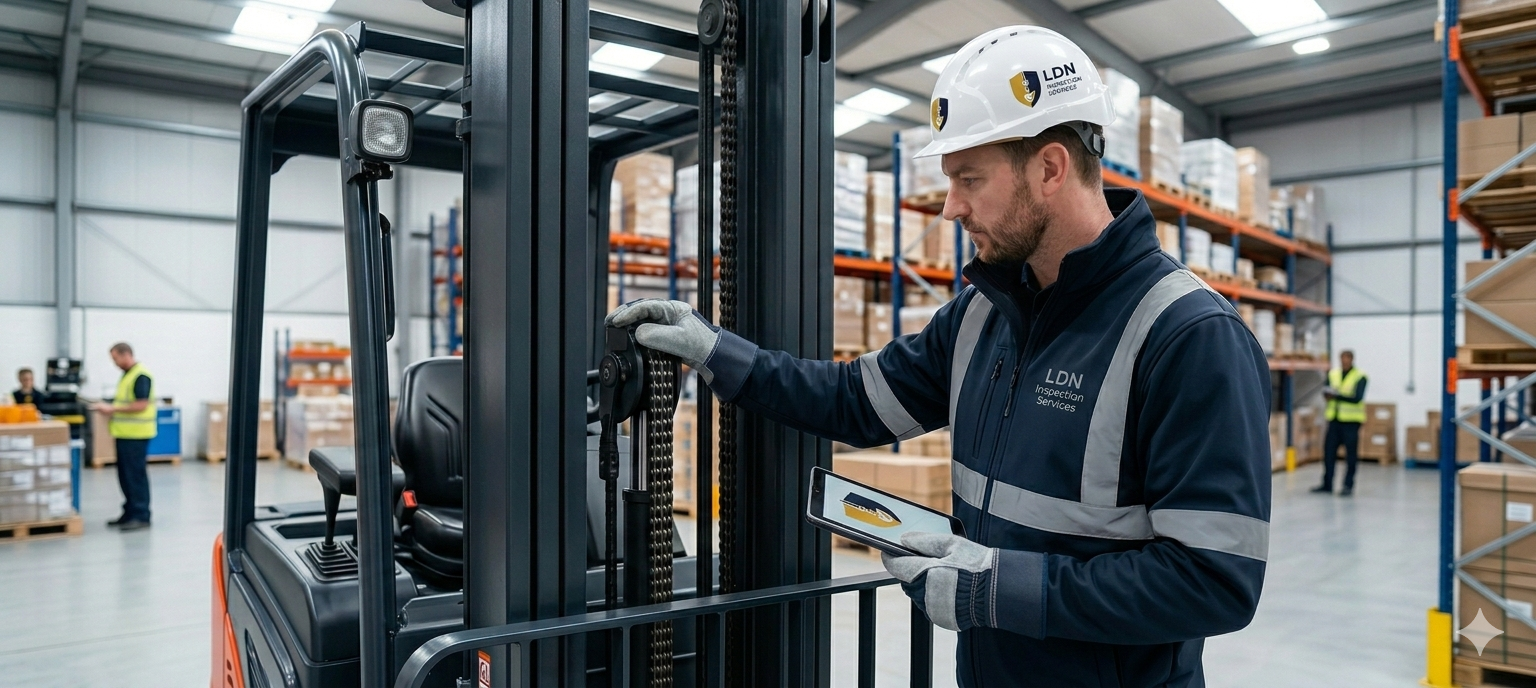
Consider a forklift truck. Under PUWER, it must be:
- Maintained in safe working order
- Inspected at appropriate intervals
- Operated only by trained personnel
- Fitted with appropriate guards and safety devices
Under LOLER, that same forklift must also:
- Undergo a thorough examination every 12 months (or more frequently if recommended by the competent person)
- Be used only for properly planned lifting operations
- Be clearly marked with its safe working load
- Have a current report of thorough examination available
In short, LOLER adds additional, more specific requirements on top of the general PUWER obligations. Complying with LOLER alone is not enough -- you must also meet PUWER requirements, and vice versa.
Common Mistakes Businesses Make
Based on our experience carrying out thousands of inspections across London and the South East, these are the most frequent compliance failures we encounter:
- Assuming LOLER covers everything: Businesses with lifting equipment sometimes believe that a thorough examination under LOLER satisfies all their obligations. It does not. PUWER requirements for maintenance, training, and guarding still apply.
- Confusing maintenance with thorough examination: A regular service or maintenance programme is not a substitute for a thorough examination under LOLER. These are separate legal requirements.
- Not inspecting non-lifting work equipment: PUWER requires inspection of any work equipment where there is a significant risk. Many businesses overlook items like workshop presses, power tools, or gym equipment.
- Failing to keep proper records: Both regulations require that inspection and examination records are maintained and available for review. Missing paperwork can result in enforcement action.
How to Ensure Compliance with Both Regulations
Staying compliant with PUWER and LOLER does not need to be complicated if you take a systematic approach:
- Create an equipment register: List every piece of work equipment on your premises. Identify which items are lifting equipment (and therefore subject to LOLER in addition to PUWER).
- Establish a maintenance schedule: Ensure all work equipment is maintained in accordance with manufacturer recommendations and your risk assessment.
- Schedule thorough examinations: For all lifting equipment, arrange thorough examinations at the required statutory intervals with a competent person.
- Keep training records: Document that all operators have received adequate training for the equipment they use.
- Retain all reports: Keep inspection records and reports of thorough examination readily accessible for at least the period until the next examination is due.
- Appoint a competent inspection provider: Work with an inspection body that understands both PUWER and LOLER and can advise you on your full range of obligations.
How LDN Inspection Services Can Help
At LDN Inspection Services, we carry out both PUWER inspections and LOLER thorough examinations across London, the South East, and throughout the UK. Our team of experienced, competent engineers can assess your full equipment inventory and provide a clear, practical compliance programme tailored to your business.
Whether you operate forklifts, cranes, MEWPs, passenger lifts, gym equipment, playground equipment, or general work equipment, we can help you meet your legal obligations under both PUWER and LOLER -- efficiently and without unnecessary complexity.
Get in touch today to discuss your inspection requirements or to request a no-obligation quote.
Work Equipment Inspection
LDN Inspection Services provides thorough examinations and statutory inspections for lifting equipment, pressure systems, and work equipment across the UK. Our competent engineers deliver fast, reliable reports to keep your operations safe and compliant.
Book InspectionFrequently Asked Questions
No. Maintenance and thorough examination are separate legal requirements. Maintenance (servicing, repairs, upkeep) keeps equipment in good working order, while a thorough examination is a detailed, independent assessment of the equipment's safety carried out by a competent person. A regular service does not satisfy the requirement for a thorough examination under LOLER, and a thorough examination does not replace the need for ongoing maintenance under PUWER.
Thorough examinations must be carried out by a competent person -- someone with the appropriate practical and theoretical knowledge and experience of the equipment being examined. They must be sufficiently independent to make objective decisions. In practice, this is usually an engineer from an accredited inspection body, though suitably qualified in-house engineers may also meet the competence requirements if they have the necessary independence.
Yes. Because lifting equipment is also work equipment, both PUWER and LOLER apply simultaneously. PUWER covers the general requirements for suitability, maintenance, inspection, training, and guarding. LOLER adds specific requirements for thorough examination, planning of lifting operations, safe working load markings, and defect reporting. You must comply with both sets of regulations for any lifting equipment.
Yes. LDN Inspection Services provides both PUWER inspections and LOLER thorough examinations across London, the South East, and throughout the UK. Our team of competent engineers can assess your full range of work equipment and lifting equipment, providing a clear compliance programme that covers all your obligations under both regulations.
LDN Inspection Services
We are a specialist inspection body delivering statutory examinations of lifting equipment, pressure systems, and work equipment to businesses across the United Kingdom. Our team of competent engineers is committed to helping duty holders meet their legal obligations efficiently and without disruption.